CORE INSIGHTS & TAKEAWAYS
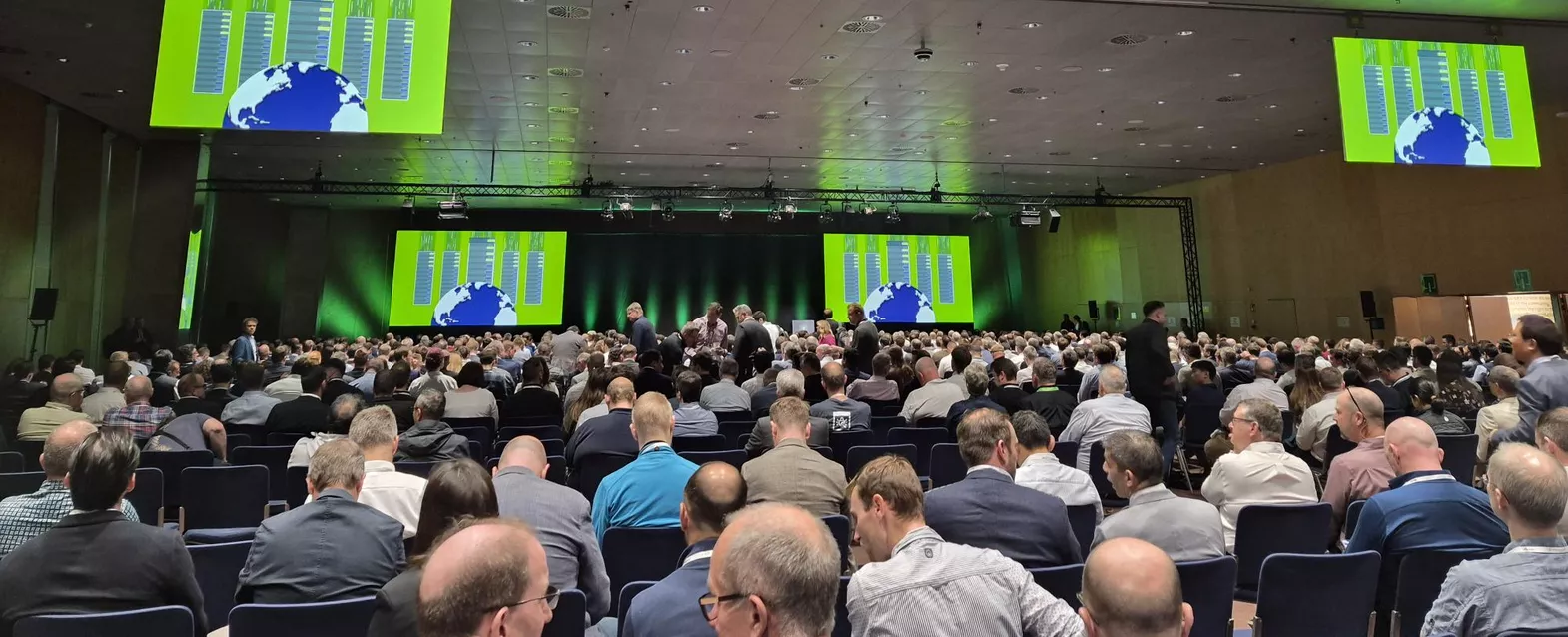
OCP EMEA Barcelona 2026
The OCP EMEA Summit is one of the clearest windows into where the open hardware ecosystem is heading. Engineers, operators, architects, and infrastructure teams from across the hyperscale and enterprise compute world converge every year to work through the hard problems.
This April in Barcelona, the apheros team was present to understand where the technical consensus is forming, where the gaps are, and what the standardization pipeline looks like for direct liquid cooling infrastructure. We came back with a sharper view of an industry that has decisively crossed a threshold.
A number that changes the architecture
The 1MW rack
The reference point that framed much of the summit's technical discussions was 1 megawatt per rack. That is the density target now being designed around for next-generation AI clusters. It is the engineering problem that infrastructure teams are solving for today.
To understand what that number means in practice, consider what it implies for cooling. A 1MW rack dissipates heat at a rate that would require moving such an enormous volume of air that are physically incompatible with the spatial constraints of a high-density data center floor. The energy cost of running that airflow at scale is prohibitive. The acoustic and mechanical infrastructure required to manage it is unwieldy. Air cooling, at this power density, is not a suboptimal solution. It is not a solution at all.
This is not news to anyone who has been tracking GPU power roadmaps over the last two years. What was notable at OCP EMEA was the visible shift in how organizations are responding to it. A year ago, liquid cooling discussions were still framed around evaluation: pilot programs, proof-of-concept deployments, feasibility assessments. The questions were about risk management and total cost of ownership projections.
In Barcelona, that framing was gone. The conversations were operational. Teams that were running pilots in 2024 are now building deployment pipelines. Procurement decisions are being made. Supply chains are being qualified. The 1MW rack is not a future state to plan for. It is the present state to execute against, and the entire infrastructure ecosystem is repricing its priorities accordingly.
For thermal management specifically, this shift has one clear implication: cooling infrastructure is no longer a component selected downstream of the compute architecture. It is a design constraint that shapes everything around it. The cold plate is not the last thing you specify. It is one of the first.
Where the standards work is happening, and why it matters
The most technically substantive work at OCP EMEA takes place in the workgroups, and this year the Cold Plate Base Specification sessions reflected the scale of the engineering problem the industry is trying to solve collectively.
Liquid cooling at scale is fundamentally an interoperability challenge. A deployed AI cluster does not come from a single vendor. Cold plates, manifolds, quick disconnects, coolant distribution units, and facility-side infrastructure are sourced from different manufacturers, qualified against different internal standards, and assembled by teams working from different reference designs. For that system to perform predictably and safely at 1MW densities, the interfaces between every component need to meet tolerances that are consistent, testable, and openly specified.
The Cold Plate Base Specification workgroup is building that foundation. Two areas are currently at the center of the work.
Mechanical tolerances. The workgroup is converging on a flatness requirement below 0.1mm for cold plate mating surfaces, paired with specific surface roughness specifications designed to ensure consistent thermal contact regardless of which vendor's components are being assembled together. These are demanding numbers. Achieving sub-0.1mm flatness repeatably in production (not just on a sample or in a lab setting) requires manufacturing process discipline that raises the qualification bar across the supply chain. Surface roughness specifications add another layer: the thermal interface between a cold plate and a chip package is only as good as the contact quality across it, and contact quality is a function of both flatness and surface finish at a microscopic level.
The precision required here is not over-engineering. At the power densities being discussed, a deviation of a few hundredths of a millimeter in flatness translates directly into measurable thermal resistance, which translates into chip temperatures, throttling behavior, and ultimately system reliability. The tolerances being standardized are calibrated to the physics of the problem.
Two-phase fluid specifications and high-heat flux testing. As GPU thermal design power continues to climb, single-phase liquid cooling (where coolant enters and exits the cold plate as liquid throughout) faces increasing efficiency constraints at the highest heat flux levels. The workgroup is now developing specifications for two-phase cooling scenarios, where the coolant undergoes partial phase change to absorb heat more efficiently, as well as standardized test methodologies for high-heat flux conditions.
This is forward-looking work. The GPU generations that will fully stress two-phase systems at scale are still on the roadmap. But the testing frameworks and fluid specifications need to be defined now so that the qualification infrastructure exists when it is needed. This is one of the most valuable functions that OCP workgroups serve: getting the standards work far enough ahead of the deployment curve that the industry is not scrambling to define interoperability requirements while simultaneously trying to build and ship.
For cold plate developers, engagement with this workgroup process is not optional. The specifications being written now will define the qualification requirements for any product that wants to be designed into a reference architecture.
Thermal management as baseline architecture
The OCP EMEA Summit covered a wide range of infrastructure topics. Power delivery, sustainability, facility architecture, open hardware roadmaps across compute, storage, and networking. Among the power-side discussions, 400VDC distribution received significant attention. The efficiency case for high-voltage DC is well established, and there is real deployment momentum behind it, particularly among hyperscalers.
But there is an important distinction between a topic that is under active technical and commercial debate and a constraint that has already been set by the physics of the problem.
For AI data center infrastructure, the thermal management question has moved firmly into the latter category.
Standardizing thermal interfaces (the mechanical specifications, the fluid compatibility requirements, the testing protocols, the qualification frameworks) is how you make that architecture deployable at the speed and scale the market demands.
Apheros at OCP EMEA: what we took away
Attending OCP EMEA is not primarily about visibility. It is about staying close to the technical consensus as it forms, understanding where the workgroup debates are live vs. settled, and stress-testing our own engineering roadmap against the direction the ecosystem is heading.
The direction is clear. The 1MW rack is the design target. The standardization work happening in the Cold Plate Base Specification workgroup is defining the interoperability requirements that every serious cold plate manufacturer needs to meet. The precision thresholds being discussed require genuine manufacturing capability to achieve, not just good intentions.
Apheros develops metal foam-based liquid cooling cold plates built for exactly these conditions. The thermal performance that high-density AI infrastructure demands, with the mechanical precision that vendor-interoperable deployment at scale requires. The conversations in Barcelona confirmed what we have been building toward.
Apheros AG designs and manufactures direct-liquid-cooling cold plates for AI infrastructure, high-performance computing, and green hydrogen electrolysis. Headquartered in Baden, Switzerland.